Format: Graphic Novel
Summary:
Emily and Navin are rushing to save the realm from the evil King. Emily has trouble harnessing the power of the amulet. Through friends she meets along the way, they help her see and understand what she must do to stop the King, the voice and the amulet from taking over her.
Mrs. Flo's Thoughts:
This was an amazing series! I am impatiently awaiting reading the 9th and final installment of the Amulet series. This has so much to offer and it's by far one of the greatest graphic novels I have read thus far!
Tuesday, December 10, 2019

Friday, October 25, 2019
Amulet (book 1) - Kazu Kibuishi

Kibuishi, K. (2009). Amulet. New York: Scholastic Inc.
Format: Graphic Novel
Summary:
Graphic novel star Kazu Kibuishi creates a world of terrible, man-eating demons, a mechanical rabbit, a giant robot---and two ordinary children on a life-or-death mission.
After the tragic death of their father, Emily and Navin move with their mother to the home of her deceased great-grandfather, but the strange house proves to be dangerous. Before long, a sinister creature lures the kids' mom through a door in the basement. Em and Navin, desperate not to lose her, follow her into an underground world inhabited by demons, robots, and talking animals.
Eventually, they enlist the help of a small mechanical rabbit named Miskit. Together with Miskit, they face the most terrifying monster of all, and Em finally has the chance to save someone she loves. (Goodreads)
Mrs. Flo's Thoughts:
I usually do not read graphic novels but I thought this one was really well done! It has epic world-building and the illustrations add much-needed context for fantasy creatures. One area I disagree with is the word "demon". I think it's more creature-based, but who am I to judge the synopsis?
Em and Navin are racing to through an unfamiliar world to save their loved one but they encounter something far worse than creatures. I cannot wait to read book 2 to see what happens next!
Thursday, September 12, 2019
Friday, August 23, 2019
We Are the Ship; The Story of Negro League Baseball - Kadir Nelson

BIBLIOGRAPHY
Nelson, K. (2008). We are the ship the story of Negro league baseball. New York: Jump at the sun.
ISBN 9780786808328
PLOT SUMMARY
Using an “Everyman” character, this is the story of how the Negro League paved the way for the desegregation of the Major Leagues. We are given a brief window into the lives of men and women of the early 1900’s to show the hardships they faced, not just in their daily lives but in their career choices as well.
CRITICAL ANALYSIS
Colored. Segregation. Racism. These are themes we think of when you hear the words like “bus” or “water fountain” or “schools”. Admittedly, this is not something I would have ever associated with the sports world. When you hear about the great baseball players, Jackie Robinson undoubtedly is mentioned in conversation. But, what we forget to ask ourselves is, how did he get there? This is a story of all the men before him that paved the way for the Major League world to become accepting to any player no matter the color. No longer did they have to lie about the race of a player to say “wow, he is good!”
The oil painting illustrations show a depth that brings to life the emotions of the time. We see bleak acceptance hidden in the eyes, we see the hard work with little reward hidden in the flat smiles of the players, and we see the unfiltered joy of players on the mound to an accepting crowd. Each painting is distinguished in a way that shows the myriad of players that made up the collective of the Negro League. Even though the text is lengthy, it is written in a way that readers want to continue on in the journey and the illustrations connect directly with the wording.
REVIEW EXCERPTS
“Along with being absolutely riveted by the art, readers will come away with a good picture of the Negro Leaguers’ distinctive style of play, as well as an idea of how their excellence challenged the racial attitudes of both their sport and their times.” – Kirkus Reviews May 20th, 2010
“As illuminating as the text is, Nelson’s muscular paintings serve as the true draw.” – Publishers Weekly January 2008
CONNECTIONS
*For older grades - Imagine if your teacher said boys would automatically get A’s, even if they don’t do the assignment, while girls could only reach a B maximum. How would that make you feel? What steps could you take to change the teachers mind?
*For younger grades – Have the students walk in and the ones wearing the color black get to sit in the desks while everyone else is told to sit on the floor.
Turtle In Paradise - Jennifer L. Holm

BIBLIOGRAPHY
Holm, J. L. (2010). Turtle in paradise. New York: Random House. ISBN 9780329839017
PLOT SUMMARY
A dream-chasing mother sends her daughter to live with distant relatives when her mother’s client says she does not like children. Turtle is thrust into new surroundings, new family and interesting situations that have this young girl slowly coming to love her circumstance.
CRITICAL ANALYSIS
Turtle seems a little cynical in the beginning and who wouldn’t be after their mom just dumped them like yesterday’s garage? But she understands the why behind it, she just doesn’t have to like it much. It’s refreshing to see a character show that not all children sit and do as their told, even back then. It’s also very amusing that she feels grown-ups need more advice than the kids because “[they’re] the ones who need it most.” (Holm, 2010, page 61).
She seems wise beyond her years. She knows how hard money is to come by and some of the relationships her mother must have had to the people of her new home. While the history pieces may seem irrelevant, the Great Depression era plays heavily on the events of the story. We see people barter and be kind to their neighbors and we see the greed that comes with having any money at all.
Family plays a huge part of this story and it’s not always clear they love each other. Through a series of up and down rollercoaster emotions, Turtle gets to know the grandmother who has come back from the grave the cousins who are mischievous and the man who may well be her father. It’s a lovely story showing all sides of family; the good, the bad and the hardships.
REVIEW EXCERPTS
“Holm’s voice for Turtle is winning and authentic—that of a practical, clear-eyed observer—and her nimble way with dialogue creates laugh-out-loud moments.” - Kirkus Review May 25th, 2010
“Sweet, funny and superb.” - Kirkus Review May 25th, 2010
“Depression-era story teaches history, meaning of family.” – Patricia Tauzer, Common Sense Media
CONNECTIONS
*Imagine your mom sending you away. How would you feel? Using the book for reference, compare your feeling to that of Turtle’s.
*If you woke up living Turtle’s life, how would you handle it? Would you be happy, sad, scared? Why?
The Is Not My Hat - Jon Klassen

Klassen, J. (2012) This is not my hat. Somerville, MA: Candlewick Press. ISBN 9780763655990
PLOT SUMMARY
At the start of this book, we are met with a small fish stealing a hat from a big fish. He already knows it was wrong but he did it anyway. Through an inner monologue, we see the thought pattern as the small fish tries to rationalize just how to get away with it. The big fish wakes up and is trying to find the little fish to recover his hat back. The little fish believes he is getting away with it, but a crab tells the big fish where to find him. At long last, the big fish is reunited with his stolen hat.
CRITICAL ANALYSIS
This book is one of those where you know how it will end but the journey is interesting in itself. The little fish knew it was wrong to steal and even goes to say that he knew it when he did it. The word choices Klassen use, make it very clear the little fish knew what he was doing was wrong. “I just stole it.” This book is told as an inner monologue from the point of view of the little fish. The entire book shows the little fish’s rationalization of why he stole it and how he will get away with it.
The illustrations in this book lend itself to helping the little fish hide from the big fish. My favorite page is towards the end where it is just 2 pages of seaweed. This invites the reader to help search and become a part of helping the big fish get his hat back. It also lends a certain imaginative outcome. The reader gets to decide what happened to the little fish.
Certain themes are heavily present in this book. We have all been the little fish in our lives at some point, but it’s almost instinctual to want justice. We want the little fish to get caught so balance is present. We strive to have this sense of a moral compass and to be able to distinguish from right and wrong. When someone does something wrong, we feel a deep-seated need for that wrong to be righted.
There is also the theme that all truths come to light eventually. The little fish knows crab saw him but crab said he wouldn’t tell. When big fish comes along, crab just points him in the direction of little fish. Even the book jacket has some foreshadowing going on. The inside of the jacket states, “A fish has stolen a hat. And he’ll probably get away with it. Probably.” Under this description is the little crab, who, in the end, is the one who tells the big fish where to find little fish allowing the truth to be set free and the wrong to be righted. This book is in a fabulous position of being used to teach children that even the best-laid plans can come crumbling down if the intentions behind them are not good. It can show how the truth will always come out and that cheaters never win. The little fish gained nothing from stealing and hiding away. Big fish found him and retrieved what was his, thus leaving little fish potentially labeled a thief.
REVIEW EXCERPTS
“This not-to-be-missed title will delight children again and again.” - School Library Journal: Pick of the Day September 24, 2012
“Little eyes will pore over the end pages, looking for evidence of foul play, but all the interaction between the two characters takes place where the plants grow tall and close together, obscuring the view.” - The Horn Book Magazine September/October 2012 issue
CONNECTIONS
My daughter and I read this book together and she made comments throughout to the “baby fishie” to give the “daddy fishie” his hat back. She became distraught when the little fish disappeared into the seaweed and was relieved when “daddy” got his hat back. We used this book to help her understand taking things that are not hers and not being honest will always lead to trouble.
I believe this would be an excellent beginning of yearbook to show your new class what happens to even the best-laid plans. Truth and honesty are always expected in my classrooms and this book shows how and why those traits are important.
This Is Just to Say - Joyce Sidman
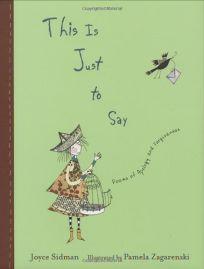
BIBLIOGRAPHY
Sidman, J., & Zagarenski, P. (2007). This is just to say: Poems of apology and forgiveness. Boston: Houghton Mifflin. ISBN 0618616802
PLOT SUMMARY
This is a book of apologies in verse form. Mrs. Merz sixth grade class is asked to write poems of apology. The students then decide to write back to their classmates. While exploring the depth of students’ ability to apologize and forgive, we see answers run the spectrum; some are remorseful while others couldn’t care any less.
CRITICAL ANALYSIS
Poetry is often thought of as rhyming long sentences into couplets or a set pattern such as ABBA. This is simply not the case. Poetry comes in many forms and varieties and offers up the author’s emotions in a way that bares the soul. This Is Just to Say takes the classroom of sixth-graders and shows a myriad of different writing styles and techniques. Some show short staccato-like rhythm with one or two words in a line, whereas, some take the expected approach of rhyming long lines to form sentences or coherent thought.
The emotion in each piece in this collection of poems runs the gambit of being deeply remorseful for their actions spanning all the way into I-don’t-care territory. Some show you the child truly has thought long and hard upon their actions and will never repeat them. Others are less caring of others and tell you straight up “I’d like to say I wouldn’t do it again but I’d be lying.” While neither is the wrong approach to their apology poems, I believe the exercise allows the class to tell the truth without being burned by the recipient if they do not accept the apology.
Each separate character is able to show their own unique personality through their writing style. Many people do not understand that when you write, you share a deeply personal piece of yourself to viewed and criticized by a large audience. These children were writing simple apology notes and responding to others, but in this writing exercise we can see those that have the capacity to forgive and those who do not.
REVIEW EXCERPTS
“Sideman’s ear is keen, capturing many voices. Her skill as a poet accessible to young people is unmatched… this is an important book both for its creativity and for its wisdom.” – School Library Journal, Starred Review
“Packed with the intensity of everyday pain and sorrow, kids and adults exchange the words that convey grief, delight, love and acceptance of themselves and others.” – Kirkus review
CONNECTIONS
*Show students that everyone has to apologize at some time in their life and it’s ok to do so. It’s also good form to accept the apology and move on. Do not dwell on it. This could be used as a tool to model how the apology process will be in the classroom.
*Creative writing exercise where students mimic the book activity and write an apology note to someone and then have to respond to someone who apologized to them.
Subscribe to:
Posts (Atom)